




PROJECT REPORT FROM SHUNTING TECHNOLOGY
TeleTrac RW110 DH Converted to Electric Drive for Salt Loading
Short travel distances, frequent shunting movements, and a clearly defined operating environment: For precisely these applications, we converted a TeleTrac RW110 DH—which we built ourselves in 1995—from diesel-hydraulic to battery-electric-mechanical.
The goal of the project was to technically upgrade a proven existing vehicle so that it better fits today’s operational profile. Instead of a diesel engine, a fully electric drive system will be used in the future. This allows the vehicle to be operated in a more environmentally friendly manner during daily operations and specifically adapted to changing requirements.
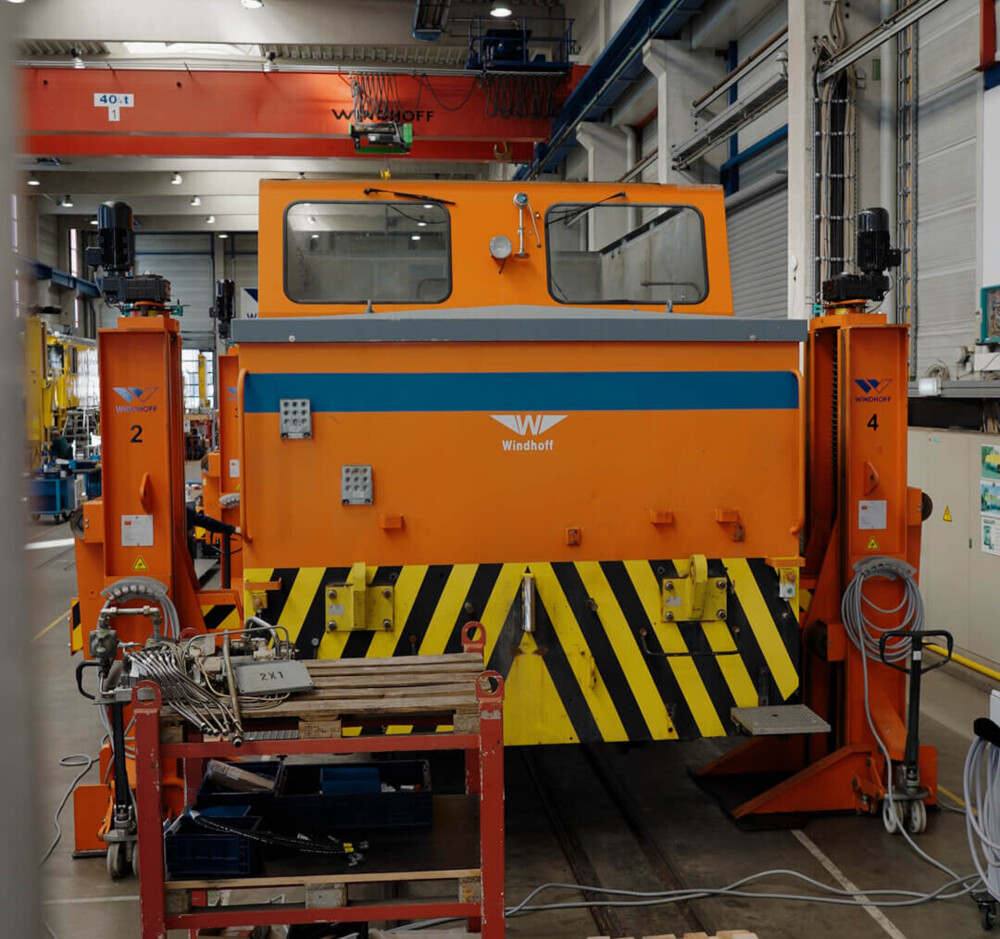
In on-site operations, travel distances are often short, processes are repetitive, and requirements are clearly defined. For this type of application, a conventional diesel engine isn’t always the most sensible solution. That’s exactly why our customer decided to electrify the vehicle. Especially for short distances and repetitive maneuvering tasks, the electric drive offers operational advantages because it is better suited to this application profile.
For us, the key was not simply to swap out the technology, but to consistently approach the vehicle from the perspective of real-world use: Which components are actually needed? How can they be integrated in a way that preserves functionality, accessibility, and ease of maintenance?
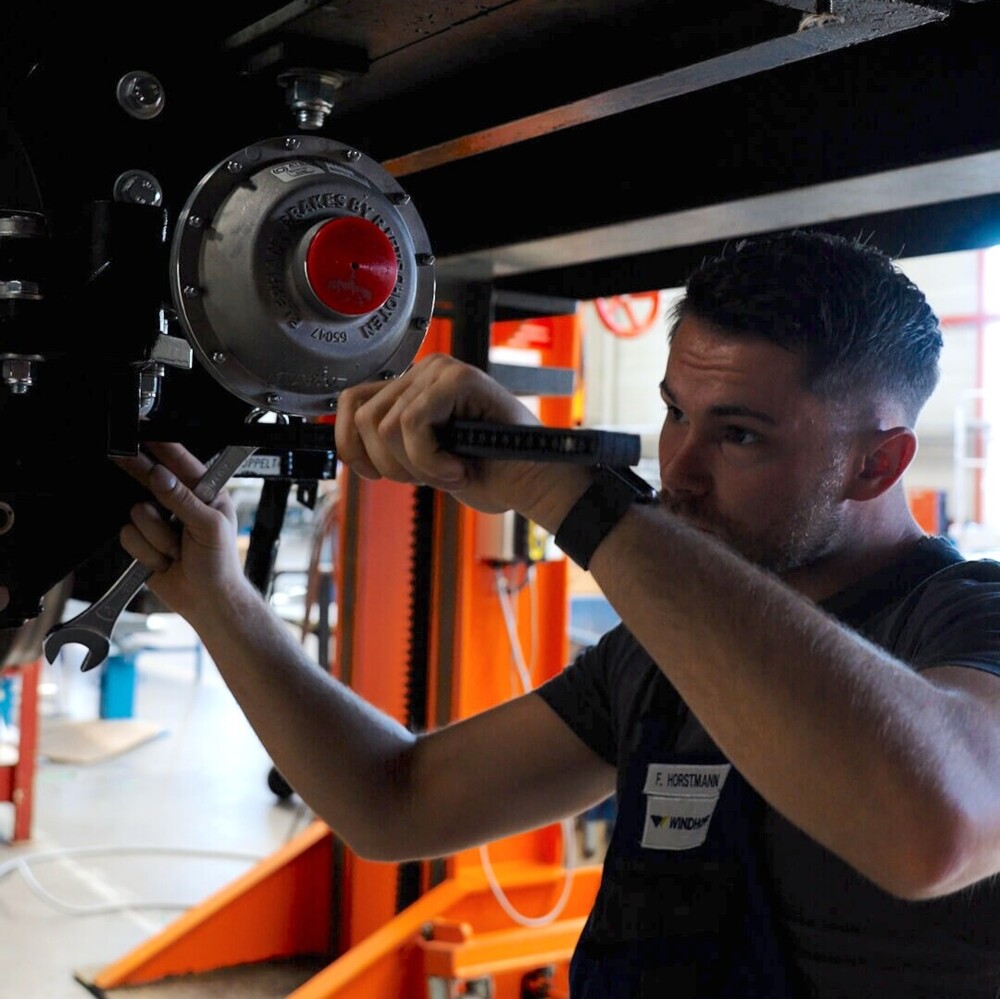
Underground work on the TeleTrac RW110 DH as part of the electrification project
From a Existing Vehicle to an Electric TeleTrac
Since this was an existing vehicle, the project did not start with a blank slate. The TeleTrac was first stripped down to make room for the new drive technology. Our team then integrated the new components in such a way that functionality, service access, and weight distribution all worked together seamlessly.
The installation situation posed a particular challenge. Older vehicles, in particular, often offer only limited installation space and are not designed for today’s electric components. Added to this was the weight of the battery technology: The battery system weighs in at around 3.5 tons and had to be integrated into the vehicle design with corresponding precision.
Experience from Multiple TeleTrac Conversions as an Advantage
This is now the third vehicle of its kind to be converted at WINDHOFF. The experience gained from several comparable conversions allows us to tailor technical
solutions even more precisely to the specific application.
At the same time, no conversion is a mere repetition. The vehicle dates from a time when identical parts were not yet used everywhere in series production. Therefore, differences in the vehicle fleet must be reevaluated each time in terms of engineering and integration. At the same time, modern components today open up additional possibilities for the technically sound further development of existing vehicles.
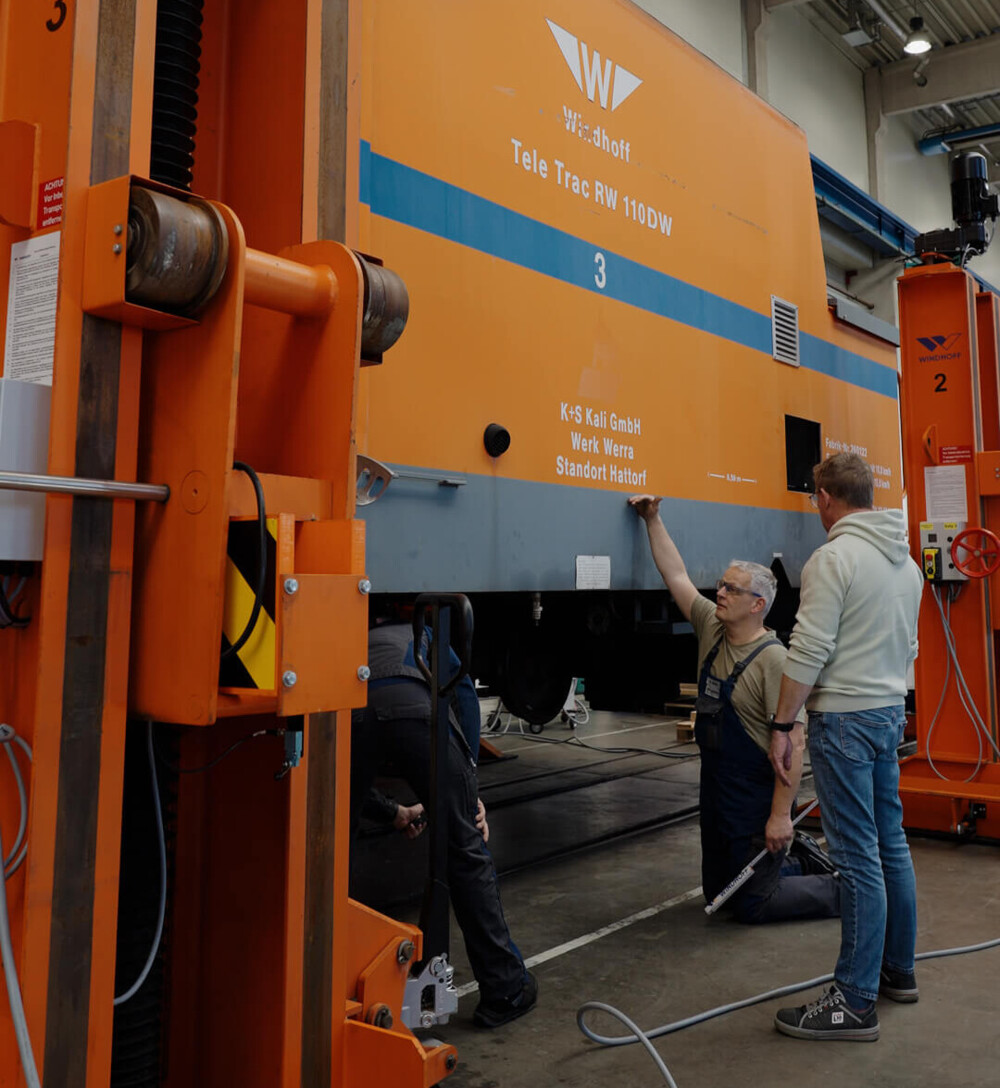
Technical Coordination for the Conversion of the TeleTrac to Electric Propulsion
TeleTrac Prepared for Salt Loading with Electric Drive
The conversion transformed an existing diesel-hydraulic shunting vehicle into an electric solution that is significantly better suited to the operational requirements of salt loading. Following our commissioning, the vehicle is ready for future in-plant use. This allows the existing vehicle to be specifically adapted to changing operational
requirements without abandoning the proven vehicle platform.
Making existing vehicles future-proof through electrification
For WINDHOFF, this conversion is more than just a technical adaptation. It demonstrates how existing vehicles can be transitioned into a new phase of operation with the right engineering. Instead of replacing what has been proven, we specifically develop it further—with a focus on function, sustainability, and the
demands of real-world operation.
Existing vehicles often hold a great deal of potential, particularly for internal shunting and transport tasks. When technology, installation space, weight, and operational concepts are seamlessly integrated, solutions emerge that make the vehicle fleet fit for the future.

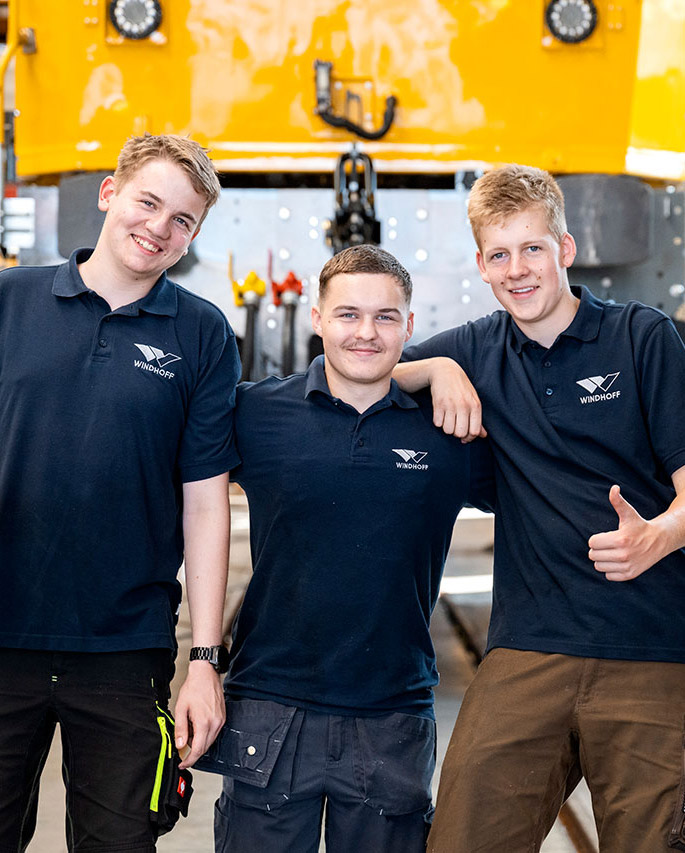
Planning of the interior fit-out as part of the TeleTrac modernization
More information about TeleTrac
Would you like to adapt an existing shunting vehicle to meet new operational requirements?
We’ll guide you through the process—from technical assessment and engineering to implementation and commissioning.
You can find more information here: